Case №1027. Kronstadt
“History is politics projected into the past.”
M. N. Pokrovsky
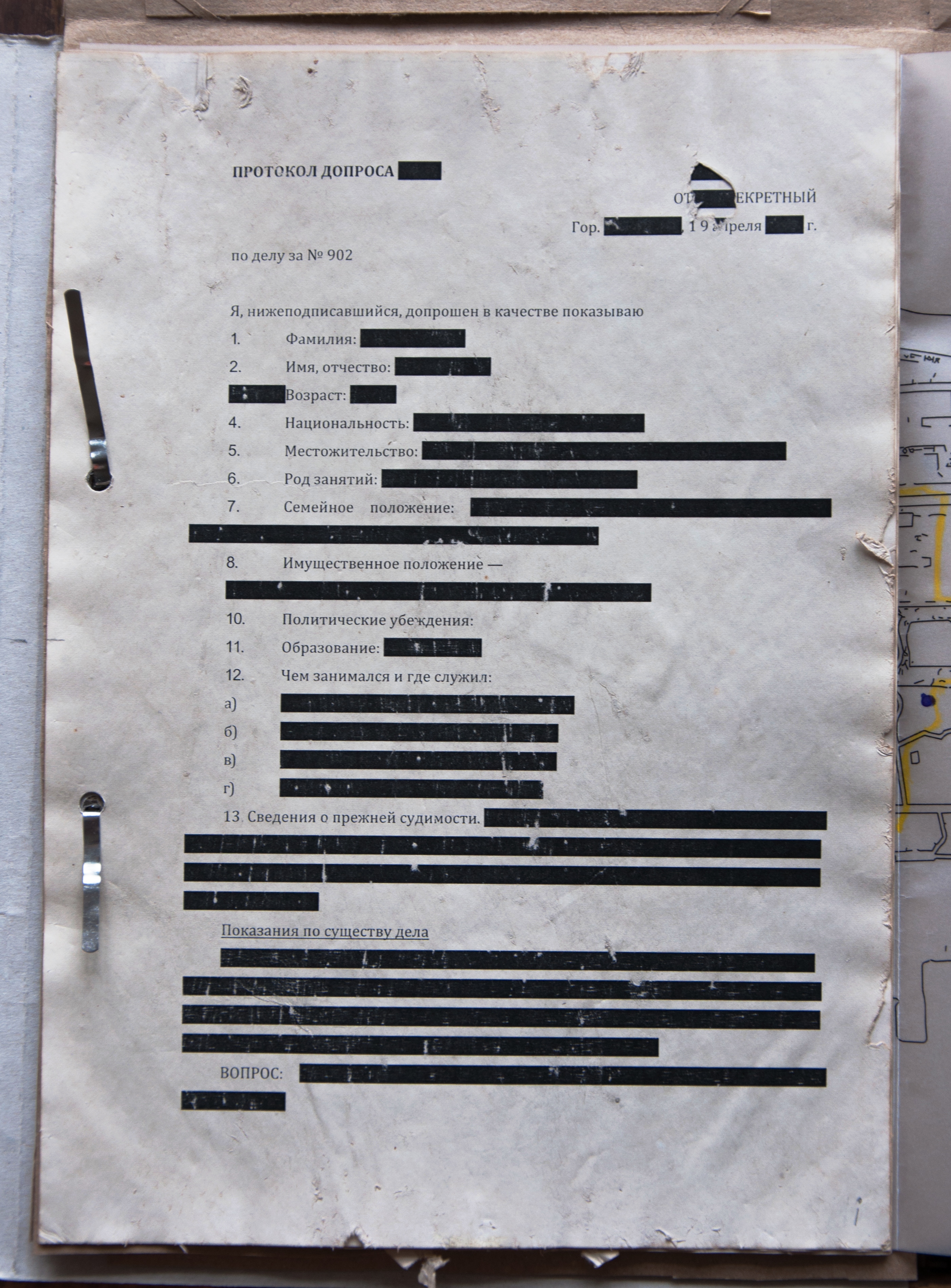
The project is based on archival materials concerning the Kronstadt Uprising of 1921, as well as on my own situationist drifts through the city. It was begun during my residency at the National Centre for Contemporary Arts in Kronstadt in December 2015 and completed in July 2016.
The project takes the form of criminal case materials and is divided into seven episodes. Each episode includes a route, a marked map, sheets containing case documents (“bureaucratic speech”), photographs, and handwritten captions (“personal speech”). The “bureaucratic speech” is based on original archival sources, yet deconstructed and reconstructed through updated vocabulary and censored through strikeouts. The photographic subjects include old military machinery scattered throughout the city, as well as other suspicious places and objects. The “personal speech” is reproduced directly from the archives without alteration.
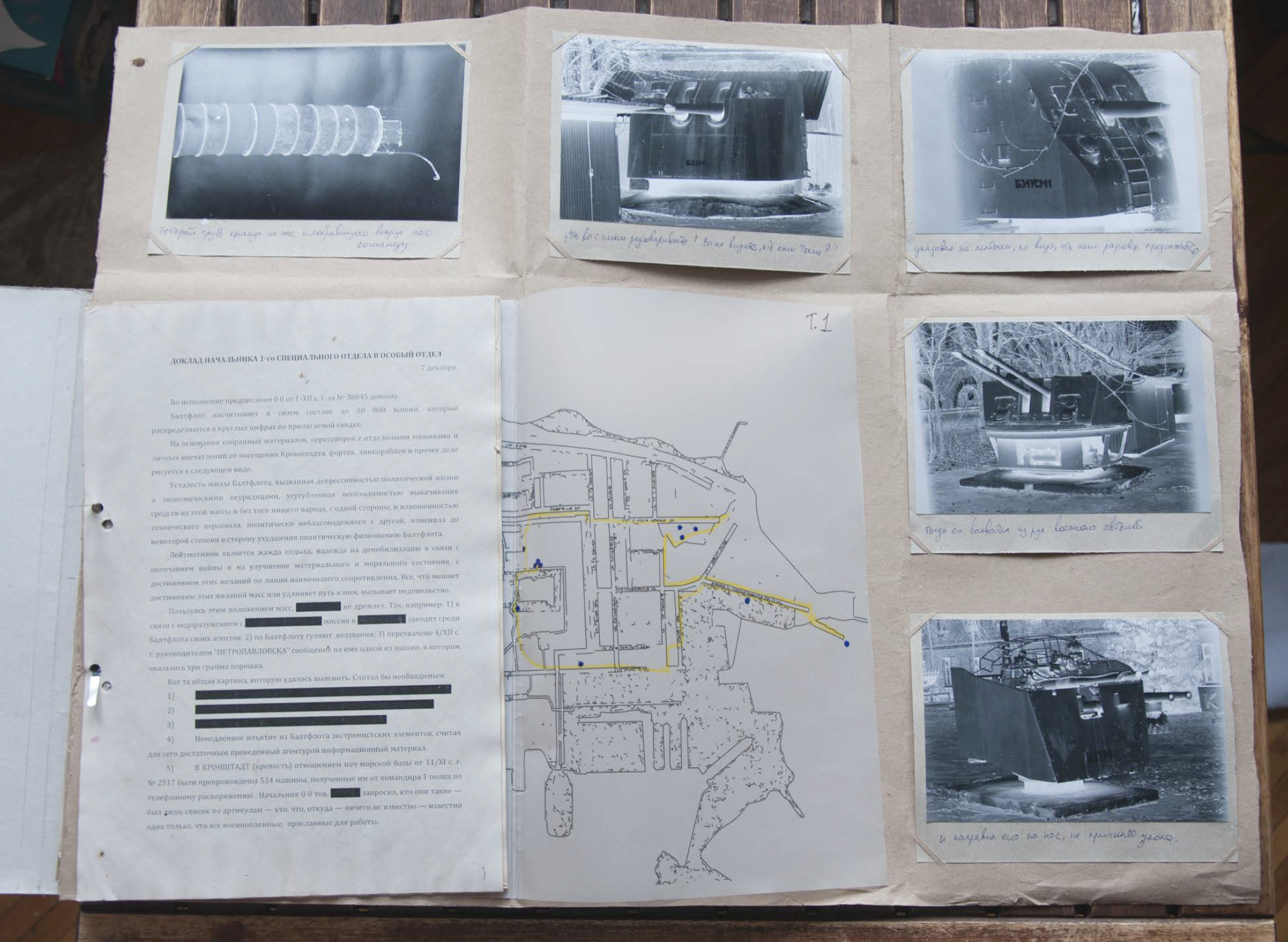
Because of this censorship, it is impossible to know when the events described in the case materials took place; it is only clear that they did occur. It is equally impossible to determine with certainty what kind of events these were. Some testimonies suggest an uprising of military machines, others the overthrow of an authoritarian regime. It has been conclusively proven that the guilty were guilty, and that all of them were destroyed. One may conclude that these events left a heavy mark on the lives and memories of people, and perhaps of machines as well, should the investigation establish that they possessed reason and feelings.
All that remains are archival data, historical artefacts, and the remnants of events. The materials are fragmented, yet intuitively assemble themselves into a larger picture. It is a cipher that may perhaps be reconstructed by entering the situation from different perspectives:
– from the position of the bureaucratic apparatus, slowly and unemotionally carrying out its work;
– from the position of bewildered people who accidentally found themselves amid the uprising;
– from the position of silent machines whose remains are scattered across the city;
– and from the position of an unknown archaeologist who methodically gathered these scattered historical facts for a purpose unknown to us. It cannot be clearly stated whose agent he was, or what he intended to prove.
History as a discipline contains a profound contradiction: it seeks to preserve objectivity while inevitably becoming subjective in the hands of particular researchers. What is objective history? What is a reliable historical fact? From which moment should one begin counting certain events? In whose interest does the historian work when assembling facts into a suspiciously coherent narrative? Can causes and consequences be separated from purely accidental factors? Does the past die within the past? What is history at all? All of these questions are, in one way or another, revealed, unrevealed, or closed within this project.
Download Case №1027. Kronstadt PDF.
Research, art-book. The result of an art residency in Kronstadt.
2016