History of fails
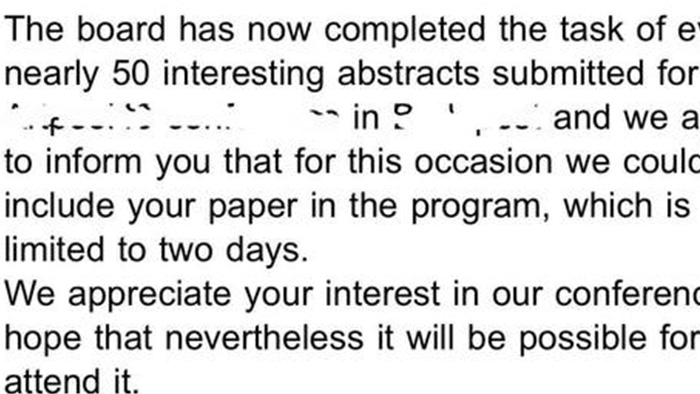
If you are a reputable organization, please scroll down below.
Recently, the artist increasingly needs to be able to build into the bureaucratic system of international residencies, grants and prizes, invent as many unique projects as possible and write tons of boring applications. However, the competition in this field is very strong and most often the artist often receives only a rejection, without any explanation.
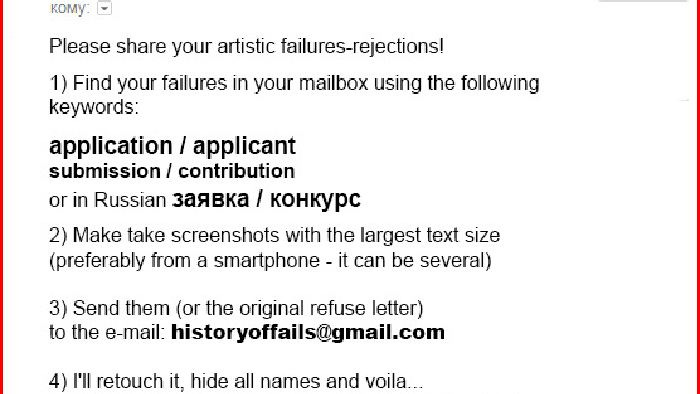
For artists:
The History needs you.
Rejections are what artists usually receive in response to their proposals. They are the majority and they are undeservedly ignored and lost in the mailboxes. I encourage everyone to share their rejections and pay attention to their wording – that's saying a lot. Put your rejections into the art history. Besides, it improves one’s mood, bodily condition, and desire to apply again.
If you are willing to share your failures – in the image, you can find instructions on the easiest way to do it.
I'm waiting for your emails – I'll take everyone (artists)!
https://www.instagram.com/historyoffails/
----
For institutions:
Video guide based on the global research
"How to write the perfect letter of rejection to the artist"
IRL: The Ideal Rejection Letter
- Apologize.
- Legitimize yourself; justify your status and authority.
- Demonstrate a significant amount of labor invested.
- Apologize once again.
- Say that the submitted work is excellent.
- Lament the limited resources.
- Optionally, explain the main reasons for rejection, in cases where it is impossible to write individual letters.*
- Apologize for the third time.
- Say that next time everything will definitely work out.
- Ask them to subscribe to the mailing list and social media.
- Wish them good luck.
* Recommended explanations:
a) small budget;
b) limited number of participants;
c) contextual or exhibition-related mismatch.
And now, an explanation.
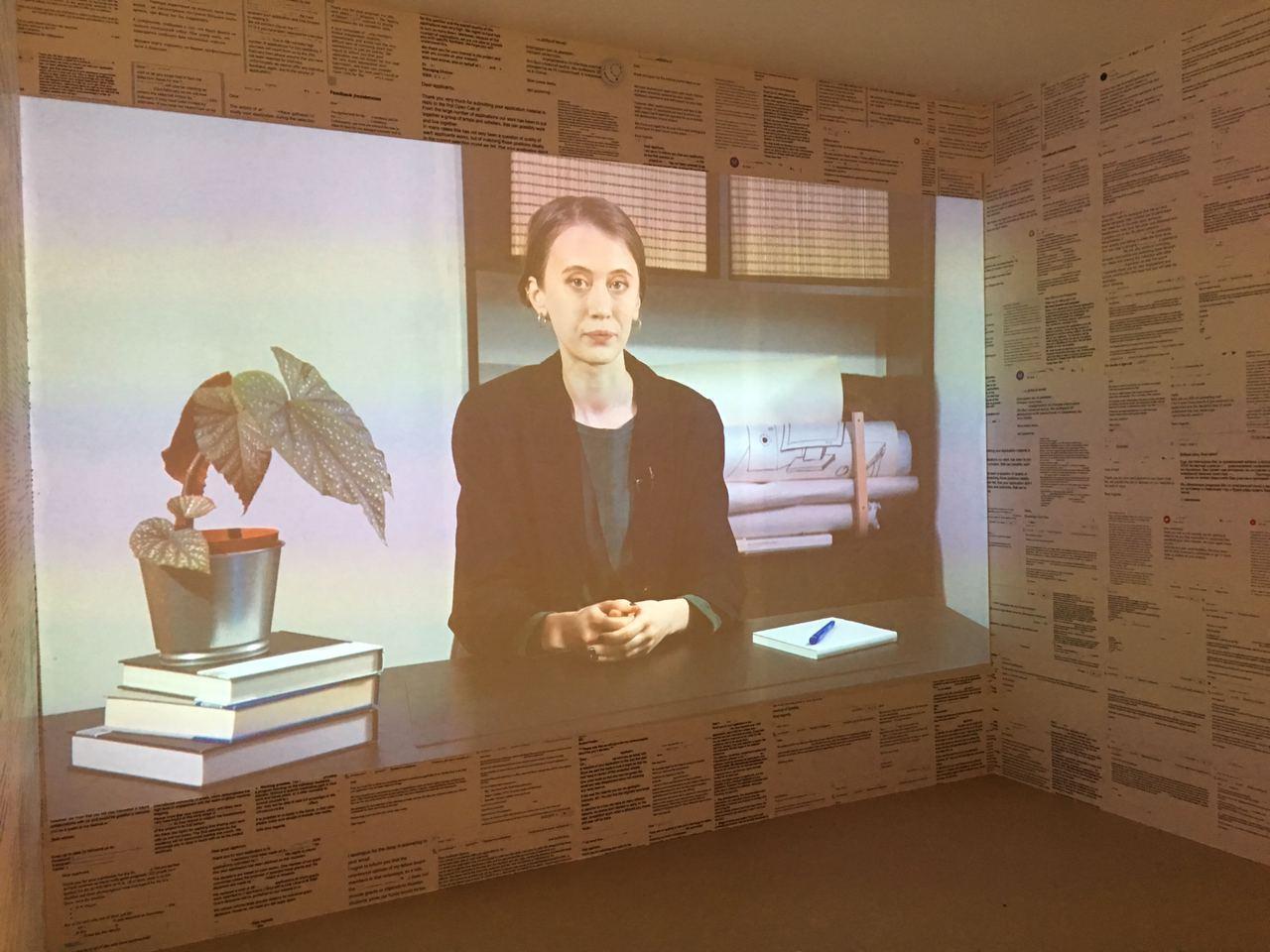
History of Fails is a project based on an archive of rejection letters received by artists from open calls, grants, residencies, and art institutions.
I collect and publish anonymized rejection letters in order to look at failure as a shared condition of artistic work. The project turns individual refusals into a collective archive and makes visible the emotional, bureaucratic, and structural pressure behind constant applications.
Through repetition, the archive reveals the standardized language of institutional rejection: polite apologies, references to limited resources, large numbers of applicants, jury decisions, and invitations to apply again. These letters often sound neutral and careful, yet they also show how power operates in the art field.
For me, the project is also ethically ambiguous. By creating an archive and an open call for rejection letters, I partially reproduce the same institutional forms that I examine. Later, when I worked as a curator and had to write rejection letters myself, the project gained another layer: I found myself on both sides of the same system.
History of Fails treats failure as artistic material, a form of collective evidence, and a way to speak about vulnerability, solidarity, and the hidden labor of being an artist.
Research-based project since 2018
Full text in Russian
Анастасия Вепрева, “History of Fails,” Syg.ma, 2020, accessed May 13, 2026, https://syg.ma/@amir-sayfullin/anastasiia-vieprieva-history-of-fails
Related interview
Artist Anastasia Vepreva on collecting rejection letters and the distinguished history of failure. Calvert journal, 2020. https://vimeo.com/424101996