Requiem for romantic love
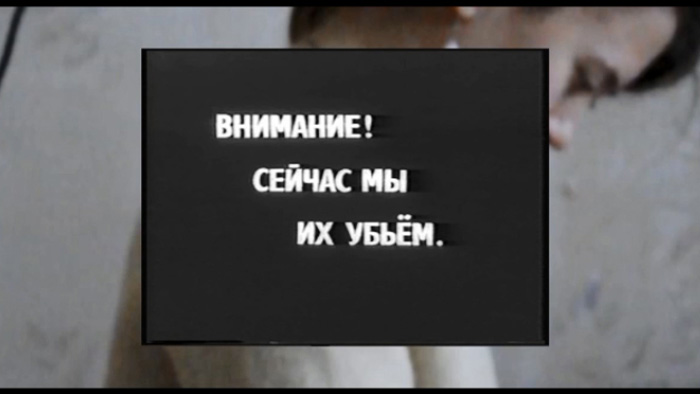
Requiem for Romantic Love is a three-channel video work that examines romantic love as a cultural script shaped by patriarchy, possession, jealousy, and pain. The work is built from found footage from Soviet films, where scenes of courtship, longing, tenderness, and emotional suffering are edited into a disturbing sequence. What usually appears as romance gradually becomes something closer to a horror film: an affective system in which love is inseparable from control.
The work takes as its starting point the familiar logic of romantic justification: he beats her, but brings flowers; he drinks, but promises her the stars; he is unfaithful, but comes home. In this structure, violence is softened by sentiment, dependence is mistaken for devotion, and suffering becomes part of the expected emotional landscape of love. The video treats romance not as a private feeling, but as an inherited image-system that teaches people how to desire, endure, forgive, and remain attached.
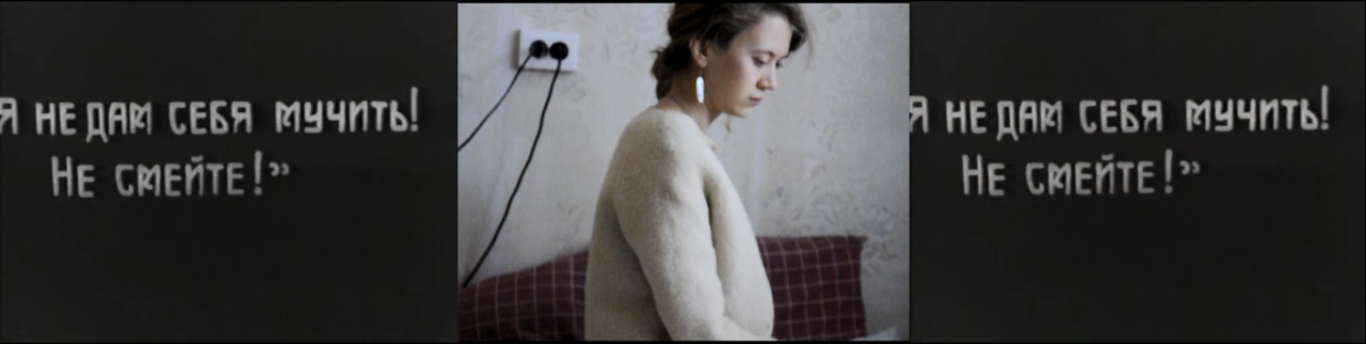
In the context of the exhibition What About Love?, I describe the work as an attempt to test the media-cultural idea of romance by exposing its elements: jealousy, suffering, and the feeling of ownership. The project emerged from the feminist workshops named after Lucy Lippard and was connected to a broader feminist analysis of love as a normative and potentially repressive structure.
The work’s visual language is based on absence as much as on image. Without dialogue, the narrative is built from looks, gestures, stiff bodies, forced embraces, and faces marked by longing or distress. In Alice Miller’s review, the work is described as a three-channel projection that collages Soviet film material and turns depictions of love into a horror film, where romance itself becomes the invisible villain.
Art historian Ella Rossman described Requiem for Romantic Love as one of the strongest works in the exhibition "И — искусство, Ф — феминизм". She reads it as a video investigation into how Soviet cinema about love shaped ideas of romantic relationships among contemporary Russian women in the post-Soviet period. According to Rossman, the work is not a detached study: these cinematic models of romance “break” the heroine and oppress her, while the video itself creates a strong empathic response.
Requiem for Romantic Love does not offer a clean escape from this affective trap. Instead, it stages the pressure of inherited romantic images and shows how they continue to inhabit the body, fantasy, and emotional expectations of the contemporary subject. Romance appears as a beautiful background for a damaged structure: a decoration that allows patriarchal and violent relations to appear meaningful, inevitable, or even desirable. David Elliott later described the video triptych as showing the romantic as “perfect background decoration” for a patriarchal, violent marriage.
Related exhibitions
What About Love? / А как же любовь? Library Arts and Music Centre, Mayakovsky Library, Saint Petersburg, 2015.
И — искусство. Ф — феминизм. Актуальный словарь. Gallery СИ / NIIDAR, Moscow, 24 October — 7 November 2015.
BALAGAN!!!, curated by David Elliott. Kampnagel, Hamburg, 2015.
Related texts
Alice Miller, “Exquisite Corpse,” This Is Tomorrow: Contemporary Art Magazine, September 2015. http://thisistomorrow.info/articles/exquisite-corpse
Анастасия Вепрева, «Любовь, порождающая сообщество», Arterritory, 18 февраля 2015. https://arterritory.com/ru/vizualnoe_iskusstvo/sut_dnja_qa/12965-ljubov_porozdajuschaja_soobschestvo/
Элла Россман, «Перевод с феминистского на феминистский. Выставка “И – ИСКУССТВО, Ф – ФЕМИНИЗМ”: критический анализ», OpenLeft, 5 ноября 2015. Архивный файл / PDF