Romantic series
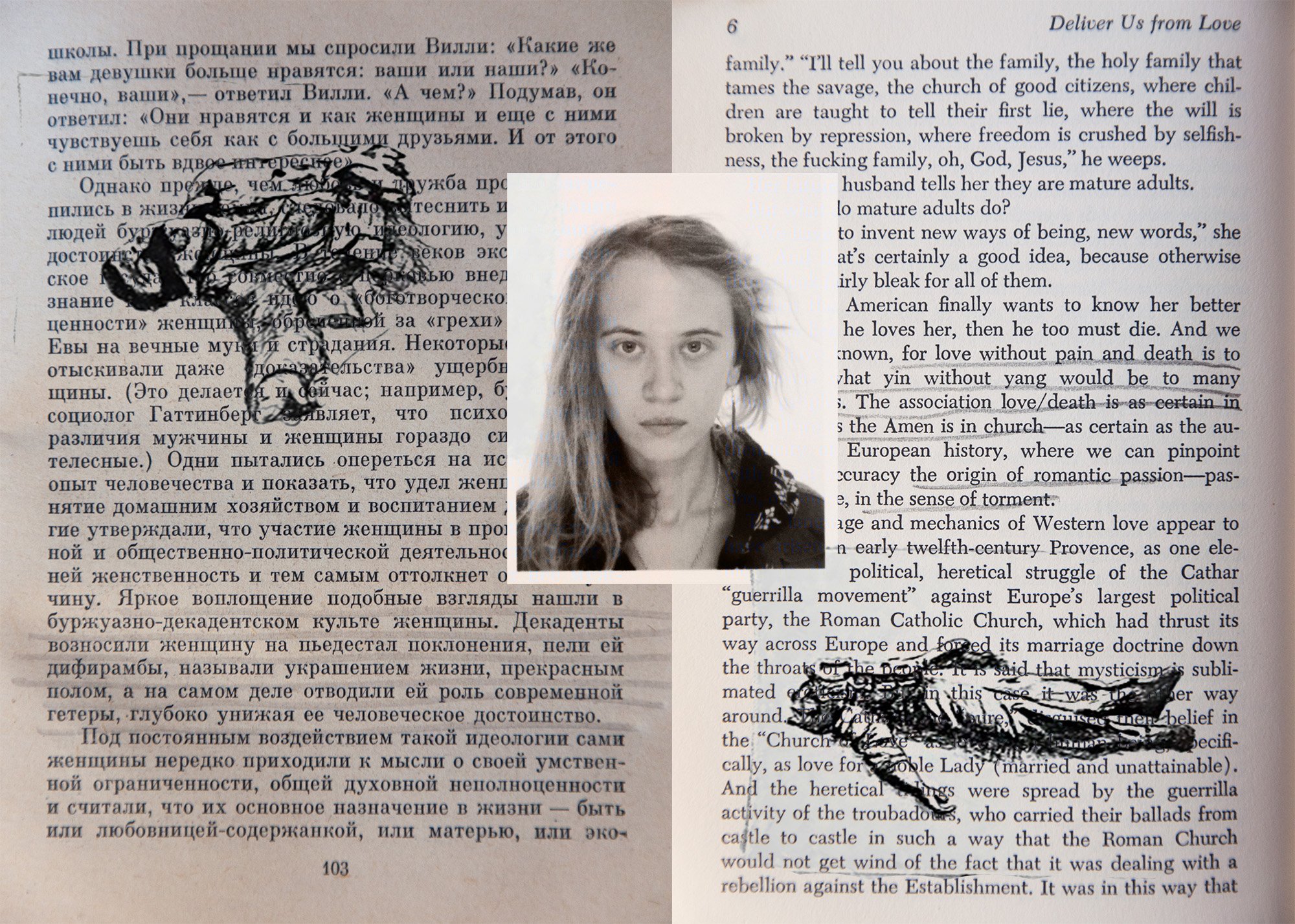
Romantic Series is a 2015-2016 project that existed as a series of videos, an exhibition at DK Roza in Saint Petersburg, and a lecture-performance. Its central theme was the figure of the Romantic hero at the moment of its collapse: the hero can no longer be a hero, love can no longer be a pure elevated feeling, the revolutionary gesture can no longer sustain its own pathos, and the striving for freedom turns into neurosis, dependency, absurdity, and a bodily symptom.
The project examines Romanticism not as a historical style, but as a living, damaged system of behavior and imagination. It brings together love dependency, stalking, technophilia, feminist critique, domestic revolutionary practice, folk song, a space launch, and absurd analytical diagrams. All these elements form a portrait of a subject who is trying to rationalize their own affective crisis, while the very language of analysis gradually begins to resemble a symptom.
The first video, Bedbug, is built around a situation of obsessive harassment. The protagonist is tormented by messages from a former lover, who is also a stalker; he acts like an invisible insect, like a bedbug that bites the body, disturbing sleep, intimacy, and the sense of safety. The protagonist scratches herself, as if the words were really biting her. Gradually she dresses herself completely in outdoor clothing, while still remaining in the space of the bed. This gesture looks like an absurd attempt to protect herself from something that has no visible source. The bed, usually associated with intimacy, rest, and love, turns into a place of anxiety and intrusion. In the end, the protagonist falls to the floor: the protection does not work, and the body cannot withstand the constant invisible pressure.
In the second video, Conversation, the Romantic code appears through landscape, contemplation, and elevated language. The video was shot in Norway: the protagonist appears against the background of an idyllic landscape, which evokes associations with the Romantic tradition: the solitude of a person before nature, the sublime, the search for truth, inner strength, and authenticity. Pathetic subtitles appear on the screen, containing reflections on truth, verity, strength, and other grand categories.
This pathos is constantly undermined by the protagonist’s behavior. She turns awkwardly in the frame, cannot assume a stable heroic pose, becomes distracted by a crow flying past, and then by an airplane. The sublime does not disappear completely, but it becomes comic, unstable, spoiled by chance. A gap opens between text and body: language wants to speak of depth and strength, while the body cannot sustain this seriousness. The Romantic subject tries to fit into the historical form of a solitary person before majestic nature, but this form no longer functions without glitches.
The third video, Technophilia, sharply changes the register. Instead of a body, a bed, or a landscape, there appears a schematic black-and-white animation of machinery: a moving excavator with its model indicated, then a fighter jet with its precise name, the dropping of missiles, a ground-based weapon that shoots down these missiles, a direct view from the fighter jet’s screen with the explosion of its target, a passenger Boeing, and, at the end, an ordinary construction crane.
This part introduces another type of Romantic desire: a desire for the machine, for power, precision, control, and destructive efficiency. The precise naming of the models turns technology into an object of almost fetishistic attention. There is no psychological depth, body, or love scene in the video; instead, a cold scheme is at work: object, trajectory, strike, interception, explosion. The Romantic dream of strength and overcoming is transferred onto the technical object. The machine becomes the new hero: it moves, sees the target, attacks, defends itself, destroys, and organizes space.
The fourth video, The Birth of Revolution out of Two Towels and a Ladle, is structured as a silent tutorial and functions as a small homage to Martha Rosler’s Semiotics of the Kitchen, where the kitchen and domestic objects become a language of power, gender, irritation, and resistance. The protagonist slowly and methodically assembles a red flag out of domestic kitchen materials: towels, a ladle, and other improvised objects.
The revolutionary symbol does not emerge from the street, the factory, the rally, or the barricade, but from the kitchen and domestic labor. But when the protagonist finally stands up and begins to wave the flag, it almost immediately falls apart. The revolutionary gesture turns out to be fragile, handmade, and technically unsustainable. After this, the protagonist bows and leaves, as if after a failed stage act. Political pathos turns into a brief scene of failure: revolution is born out of everyday life, but it cannot withstand its own symbolic weight.
The final video, Lovesickness, returns the project to the expectation of love, but pushes it toward cosmic hyperbole. The protagonist looks into the camera in a state of languor and anticipation. There is almost no external action here: the main event takes place in the face, in the gaze, and in the gradual increase of internal tension. Love is shown not as an encounter with another person, but as an autonomous state of the body and the psyche.
Through editing, this state is rhymed with the slow-motion launch of a space rocket. Anticipation turns into a technical process: pressure building up, preparation, launch, lift-off from the ground. Love longing becomes a system of thrust and overheating. The title Lovesickness emphasizes the pathological nature of this state: love appears as a symptom, as a self-arousing mechanism that produces elevation and, at the same time, reveals its physiological, almost mechanical nature.
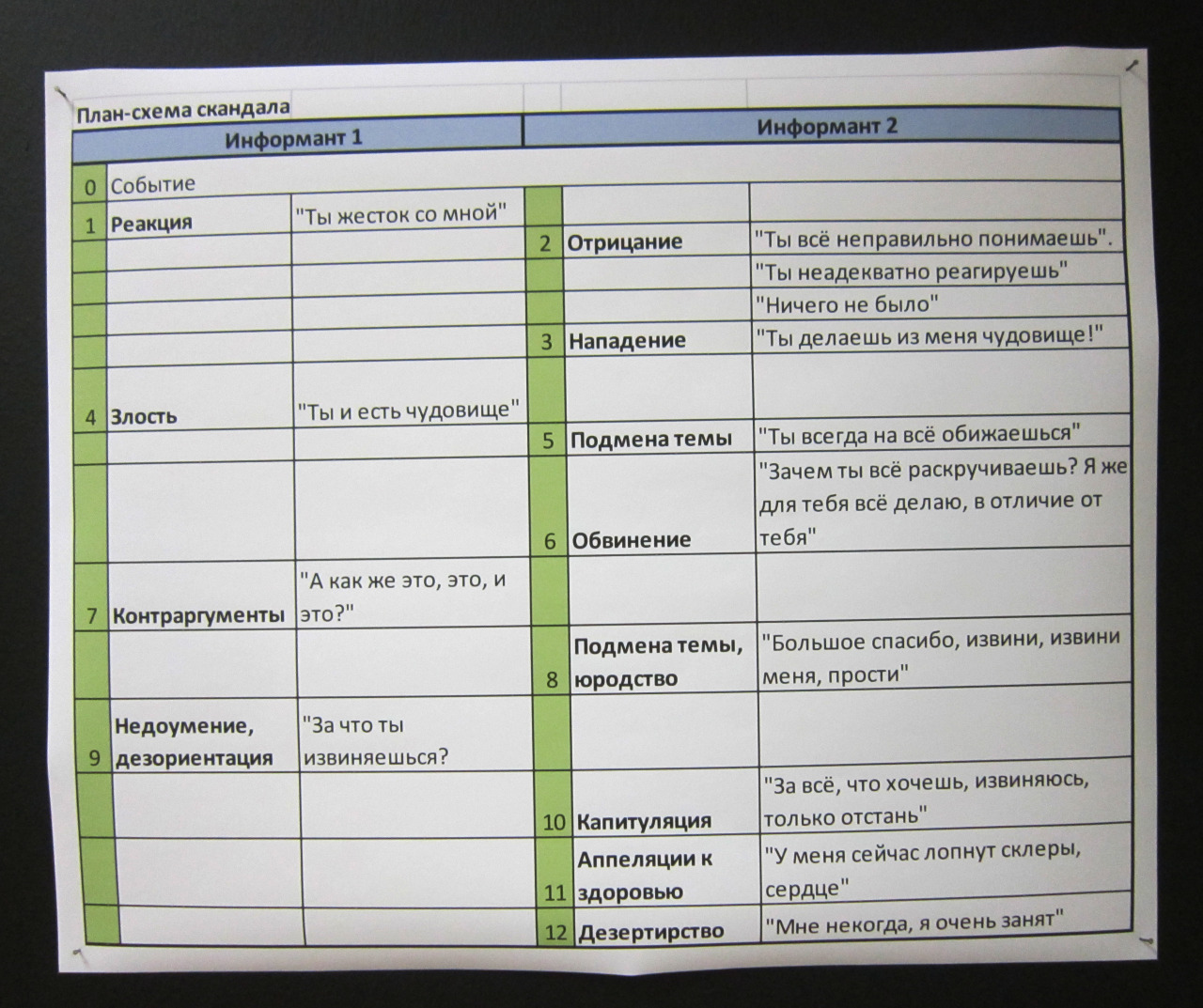
Plan-Diagram of a Scandal looks like an attempt to break down emotional destruction into logical elements. A scandal, which is usually perceived as an outburst, chaos, and loss of control, is here transformed into a diagram, almost into an instruction manual or a map of military operations. One can see in it an attempt to understand a recurring traumatic situation through rationalization: to name the stages, anticipate reactions, build causal connections, and hold chaos inside a table.
At the same time, the very form of the diagram produces absurdity. It does not resolve the conflict and does not give power over it. On the contrary, it shows that the conflict has already become a system, a recurring script within which the subject tries to think using the means available to them. The personal crisis is not presented here as a confession; it produces a specific language: dry, analytical, comic, and disturbing at the same time. The diagram becomes not an illustration of trauma, but its form.
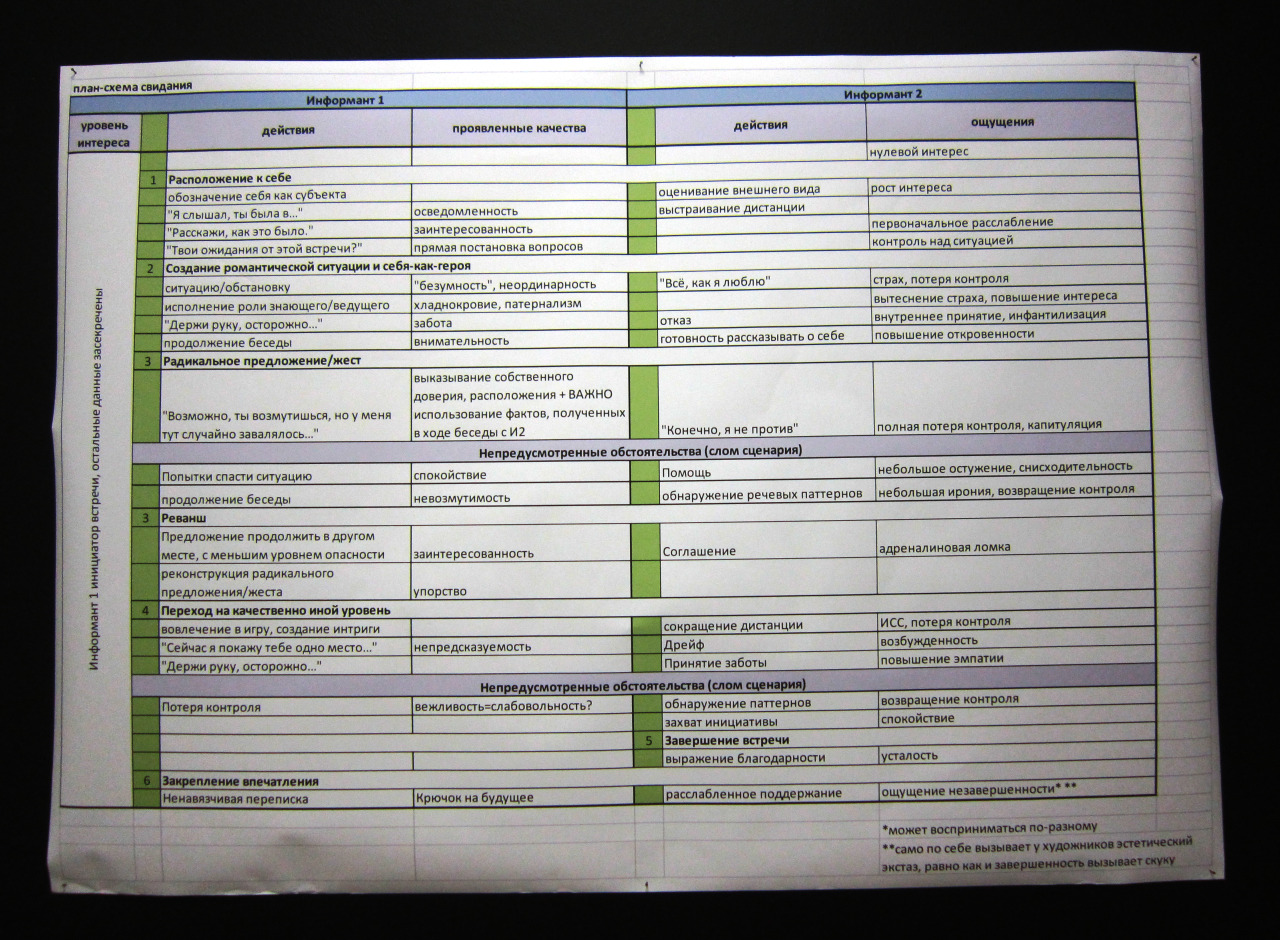
Plan-Diagram of a Date works with another side of the same emotional economy: intrigue, anticipation, seduction, the redistribution of attention, and the attempt to obtain missing recognition through love affairs. A date here ceases to be a Romantic event and turns into a strategic construction. Desire, interest, vulnerability, power, flirtation, and calculation are broken down into points, as if they could be planned, calculated, and controlled.
This diagram is especially important for understanding the project, because it connects Romantic language with the language of management. Love appears as a field of maneuvers, where the subject is simultaneously searching for rescue, confirmation of their own value, and a way out of the main destructive structure of the relationship. But instead of freedom, a new system of dependencies and scripts emerges. The diagram of a date shows not the lightness of intrigue, but an attempt to organize affective hunger in the form of a plan.
The lecture-performance Freedom Died on the Barricades, or On the Impossibility of Romanticism was structured as a fragmentary study of the Romantic hero, the sublime, love, feminism, technology, revolution, and death. Formally, it resembled a lecture: there were theses, videos, analytical diagrams, reflections, and examples. But within this form, the figure of the researcher gradually emerged as someone who did not fully control the material. She speaks in fragments, gathers strange observations, shows things seen by chance, and draws conclusions that appear both intellectual and symptomatic.
An important effect of the lecture was that the study of Romanticism itself began to take on the form of a Romantic and neurotic experience. The lecture moved from the sublime to strange visual coincidences, to feminism, to the Romantic hero, to the videos, to the diagrams, to wreaths thrown into water. Other people intruded into the process of the lecture: Marina Maraeva, performing the wedding folk song “Oy, Kumushki, Kumitesya,” which speaks more of approaching loss and death than of love, and Roman Osminkin with his poetic singing.
The lecture did not explain the project from the outside. It was part of its internal mechanism. The researcher tried to dismantle the Romantic hero, but found herself inside his symptoms: obsession, fragmentation, the pull toward the sublime, and the pull toward drama.
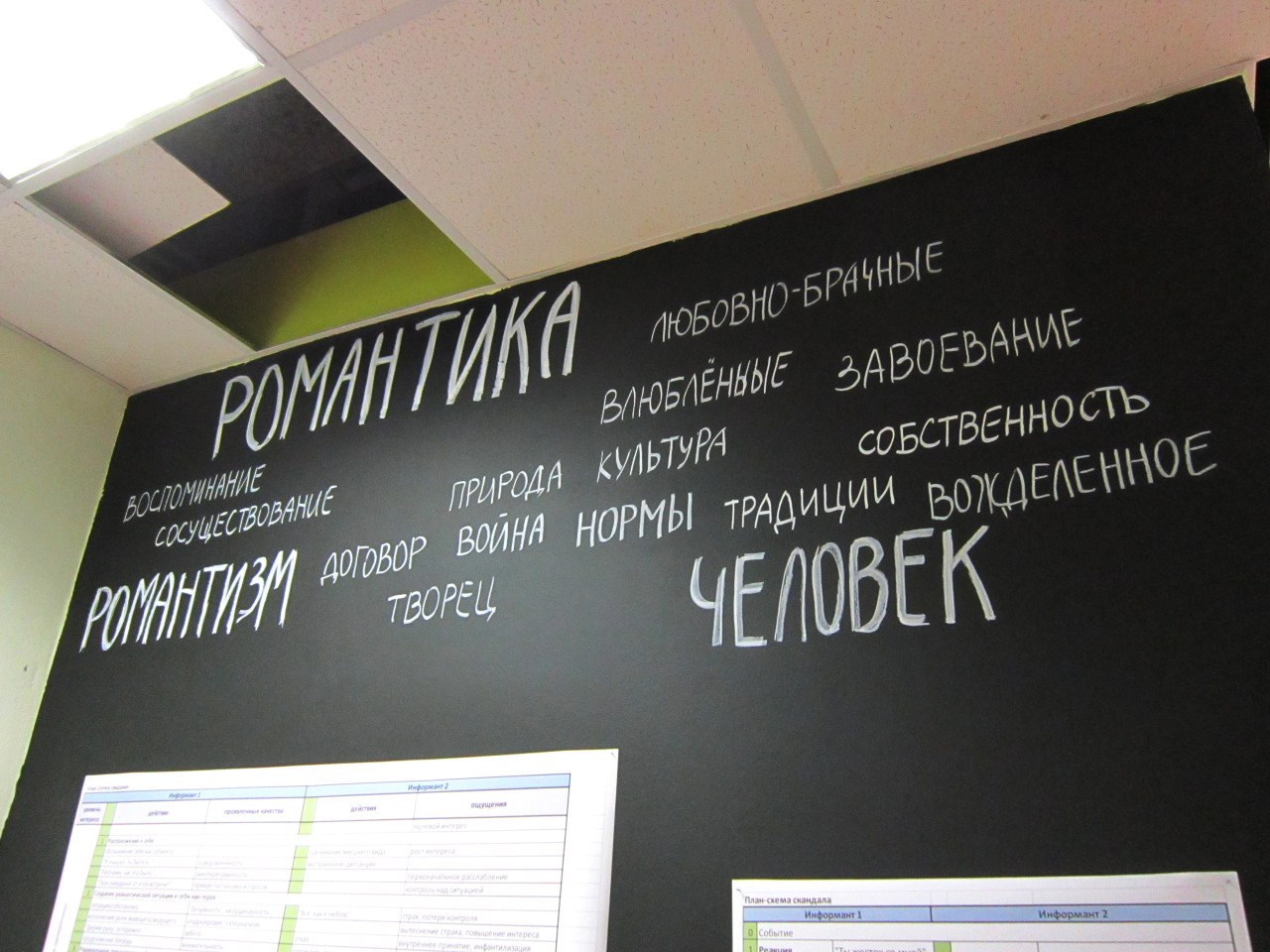
Romantic Series examines the moment when the Romantic hero can no longer exist in his former form. His striving for freedom no longer produces heroic action; it breaks down into anxiety, dependency, technophilia, domestic self-organization, love hunger, and attempts to rationalize emotional violence. Where Romanticism promised elevation, exceptionality, revolt, and an encounter with the absolute, the project discovers neurosis, stalking, diagrams, scandals, technical models, a collapsing flag, and a body that scratches itself because of messages.
The project emerged from a situation in which destructive relationships had not yet been recognized as destructive, and the only available language consisted of diagrams, videos, absurd classifications, feminist gestures, and Romantic pathos. This is not a story of recovery after trauma, but a study of how a subject thinks from within a crisis, when analysis and symptom cannot yet be separated from one another.
In this project, Romanticism is not simply criticized; its persistence is shown. The Romantic hero is dead, but his forms continue to operate: in love dependency, in the political gesture, in the cult of technology, in the artistic pose, in song, in the desire to be saved, noticed, chosen, and elevated. Romanticism can no longer be taken seriously without irony, but irony does not free one from it. It returns as neurosis, as comedy, as a diagram, as bodily itching, as a rocket on the launchpad, as a red flag made from towels and a ladle, falling apart at the moment of its first wave.