She has to
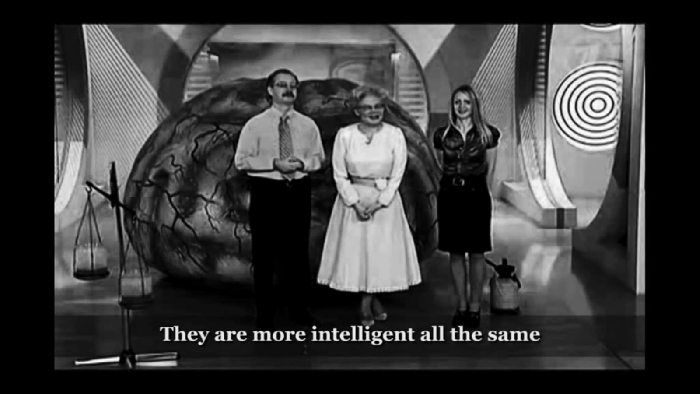
She Has To is a video work made from found footage of Russian television programmes in which women are instructed how to become proper wives, mothers, homemakers, and desirable feminine subjects. The work assembles fragments from mainstream TV shows, including advice formats where younger women are taught how to save their marriages, support their husbands, create the right atmosphere at home, and accept a secondary position within the family.
The title reduces this ideological structure to its most basic grammatical form: she has to. The sentence does not need an object, because the list of obligations is endless. She has to be beautiful, wise, kind, patient, supportive, soft, fertile, domestic, and emotionally available. She has to preserve the family, forgive, adapt, and not demand too much. The work shows how patriarchal discipline is reproduced not only through law or explicit violence, but through ordinary media language: jokes, advice, expert commentary, family values, and the supposedly harmless format of television entertainment.
It was a response to a Russian media environment in which many women believe that they already have enough rights and freedoms and therefore do not understand what feminism is struggling against. This media environment is imagined as a “huge chthonic monster” that imposes its cruel rules everywhere; the absurdity of these rules becomes visible only when one steps aside from them. The central realization is simple: “you don’t have to do anything to anybody.”
The video’s found footage makes this mechanism painfully concrete. A father builds his daughter’s room as a princess castle, coding dignity, kindness, wisdom, and beauty into a decorative environment. A host of the popular show Let’s Get Married declares that work will not give a woman a baby, while marriage is presented as the best test of personal development. In another programme, Life is Great, the host states that men should not do housework and explains this through a biological claim about male intelligence.
What makes the material disturbing is that the violence here does not appear as open aggression. It speaks through care, tradition, expertise, humour, and female authority. The work shows how misogynistic norms can be transmitted by women themselves, with the approval of male guests and studio audiences. The television studio becomes a small ideological machine where women are taught how to desire correctly, how to endure, and how to remain inside a social hierarchy that assigns them a subordinate role.
In her catalogue essay for HERO MOTHER, Bojana Pejić reads She Has To in relation to post-socialist domesticity and the return of traditional familial ideology. She notes that the video records a Russian television panel in which younger women are advised on how to save their marriages, connecting the work to the broader domestication of women in post-socialist cultures. Seen from this perspective, She Has To is not only a critique of sexism on television. It is a work about how political and economic transformations enter intimate life, how they reshape the image of the good woman, and how the command to be happy in the family can become a form of control.
Katrin Bettina Müller, writing in taz about BALAGAN!!! in Berlin, emphasized the found-footage character of the work. She notes that Vepreva did not stage the material herself, but used found footage from a Russian reality show for She Has To. Müller describes the women in the footage as advising young wives to support their husbands’ careers above all else, quoting the television line: “Men are simply more intelligent than we are.”
Related exhibitions
IV Moscow International Biennale for Young Art: A Time for Dreams / Время мечтать. Museum of Moscow, Moscow, 26 June — 10 August 2014. Curated by David Elliott.
Жена-художник — горе в семье, Parallel Programme of Manifesta 10, Art-communal apartment, Marata 33, Saint Petersburg, 2014.
BALAGAN!!! Kühlhaus am Gleisdreieck / Liebermann Haus / MOMENTUM, Berlin, 2015. Curated by David Elliott.
HERO MOTHER. MOMENTUM, Berlin, 2016.
A Doll’s House. Kapellhaus, Baku, 2019. Curated by Alfons Hug and Asli Samadova, with a contribution from Anika Meier.