Battle scenes
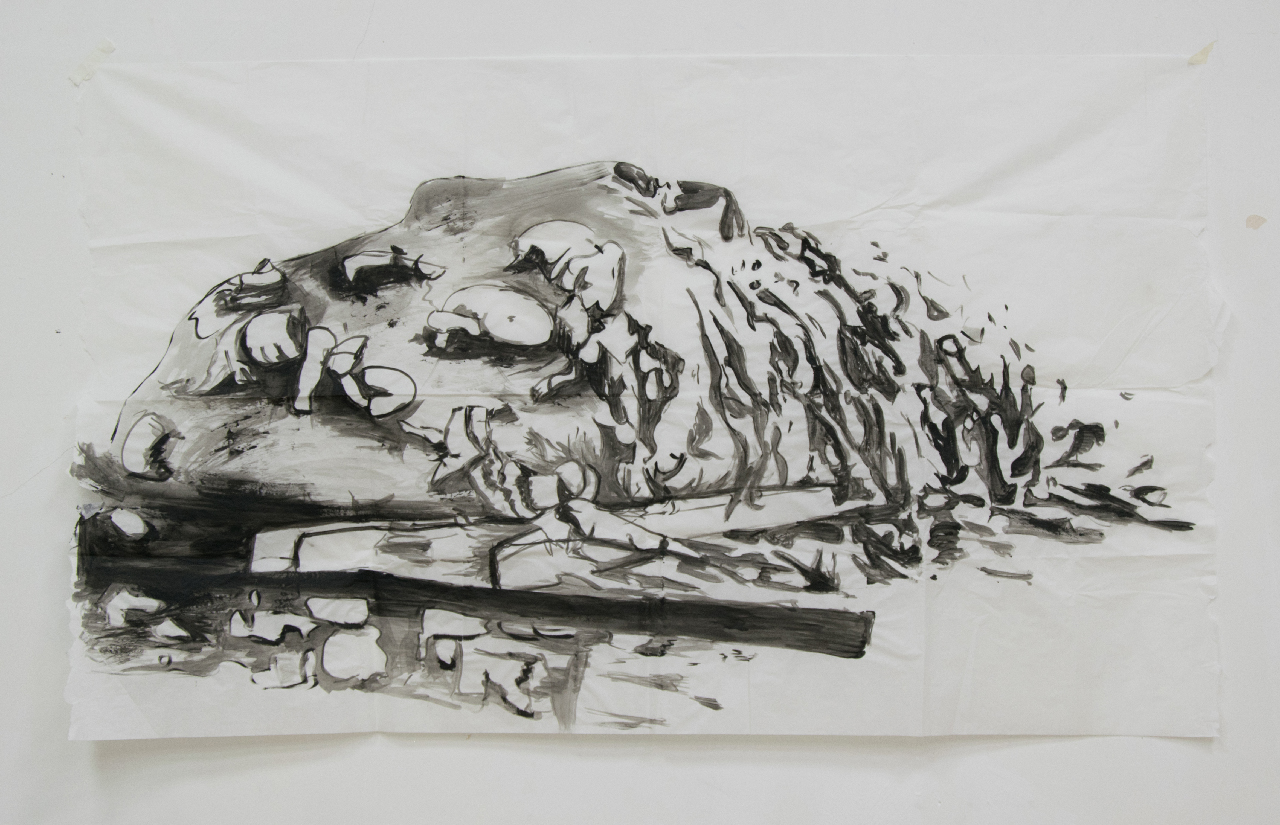
The series Battle Scenes emerged within a long-term engagement with historical memory, mass death, and images of bodies deprived of names, burial, and individual fate. It is a graphic series about the moment when an individual body ceases to be distinguishable and becomes part of a collective mass of the dead: a mass grave, a battlefield, a historical photograph, an archive of catastrophe.
In his review of the exhibition Easy, Egor Sofronov [1] writes that the series goes back to the Battle Scenes of 2016, where, through the image of a “mountain of corpses,” the work explores “the idea of the indistinguishability of the individual and their absorption into a mass of dead bodies.” He describes the graphic works as a “morphological mixing” and a “detailed interweaving of bodies into a complex of lines and tonal transitions.” What matters in the series is not only the theme of death, but also the impossibility of separating one body from another: a line, a fold of fabric, a fragment of a limb, a shadow, and a stain pass into one another, forming a dense, almost indivisible surface.
In the exhibition Easy, this work was expanded into a spatial installation. Behind a screen, accompanied by Dina Karaman’s monotonous music, several large sheets of thin paper were suspended on fishing lines. Sofronov describes this part as “crowded bodies of the dead, mass graves in grisaille tones, painfully detailed chiaroscuro, and almost academically modelled folds of fabric on military greatcoats.” These bodies are depicted in detail and at the same time lose their distinguishability: the attempt to individualise each figure merges into a common grey accumulation.
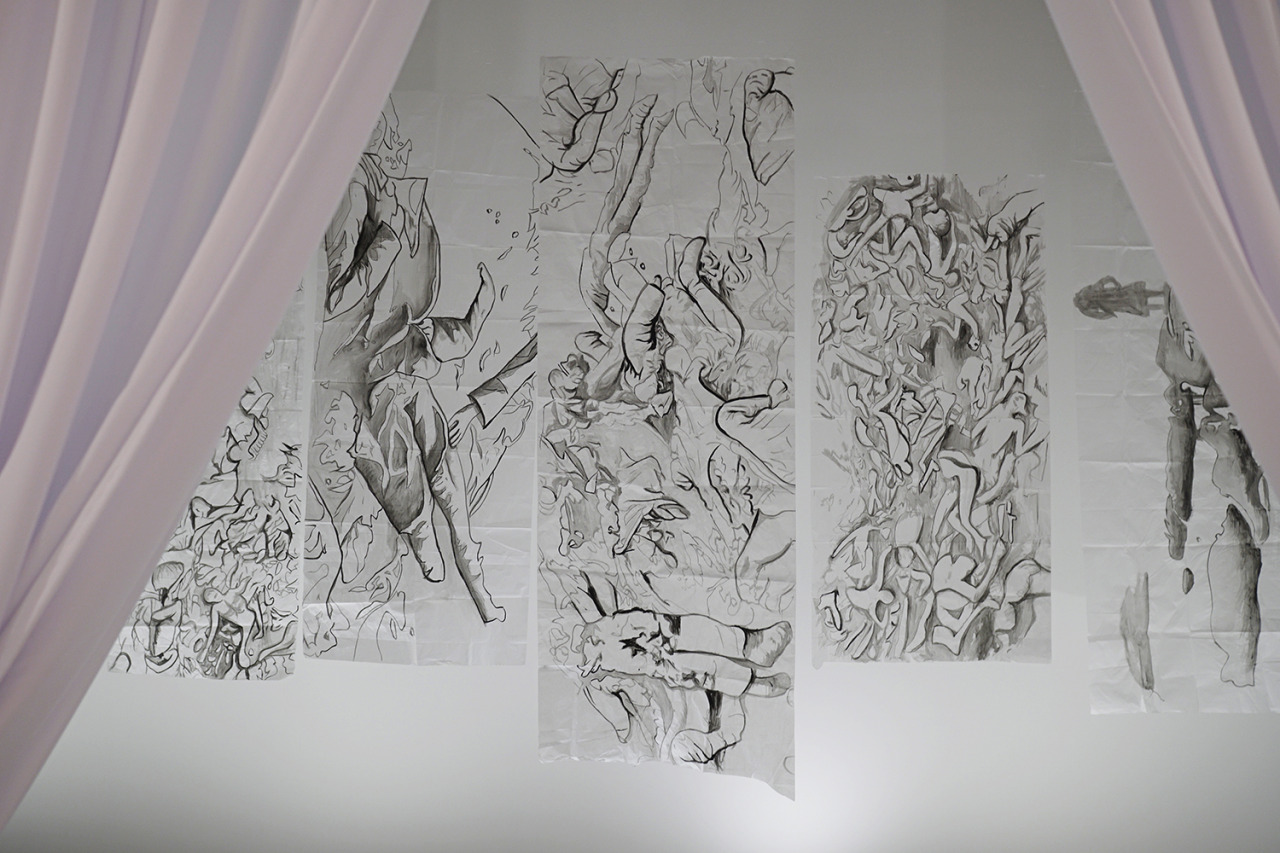
For me, it was important in this series to work not with the heroic image of war, but with what remains after it — with what is left behind after historical narratives, parades, monuments, and military rhetoric. War appears here not as an event of glory, but as a condition of bodies that can no longer speak for themselves. They lie, stick together, lose their faces and names, and become the material of history. The series is therefore structured as an attempt to look at the place where one usually cannot look for long: the place where the human body has almost become landscape.
In an interview with Iskusstvo magazine [2], I said that the exhibition Easy consisted of three parts: earth, clouds, and sky. The first part was connected with military technology and falling; the second and third parts dealt with the processing of images of the dead. The work on the project took around four years and was psychologically difficult: “the second and third parts, in fact, consist of processing images of the dead,” and this required months of working with photographs of corpses. In the same interview, an important sentence appears: “an enormous number of dead people passed through me, people whom someone had deprived of the chance to continue living. And most often that someone was military machinery.”
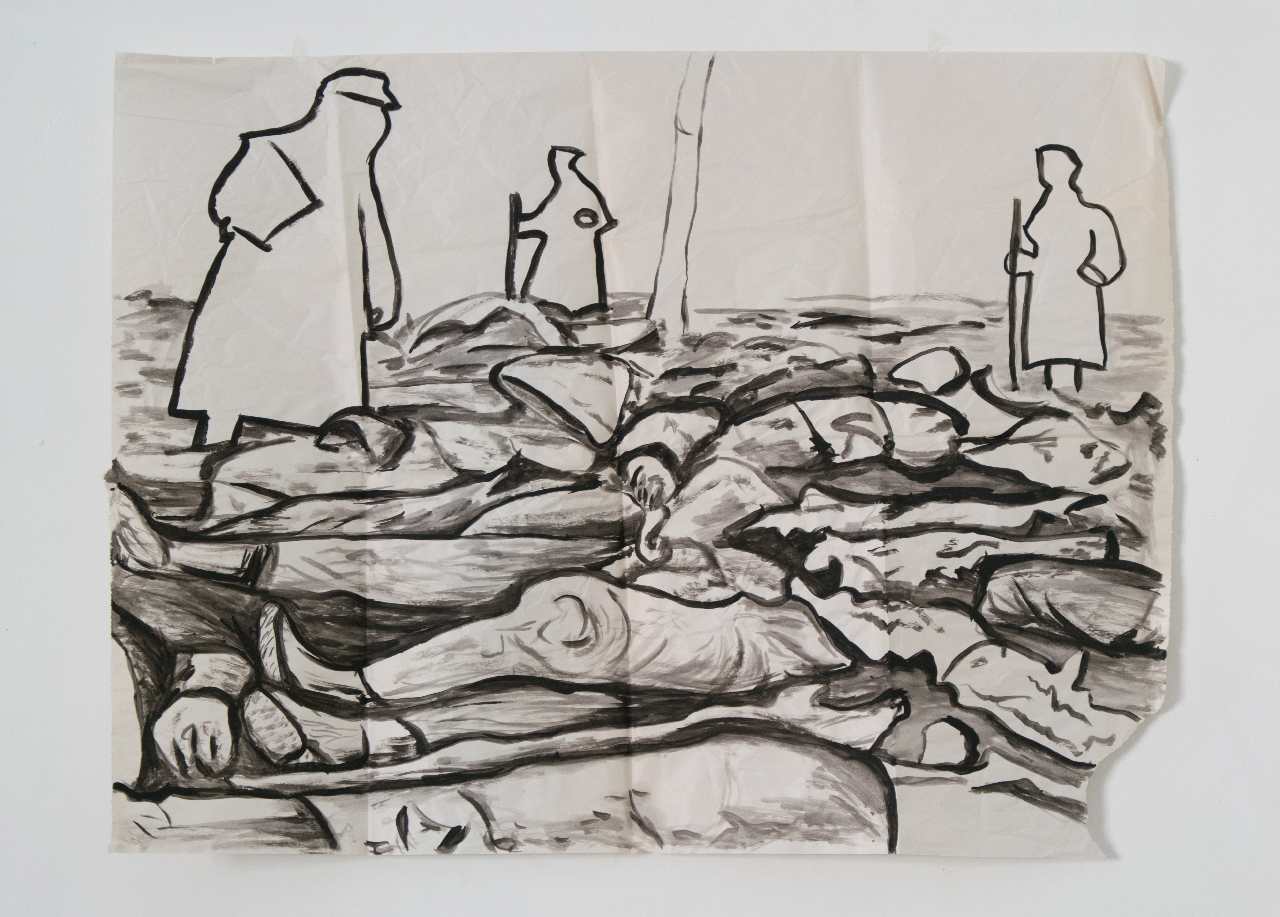
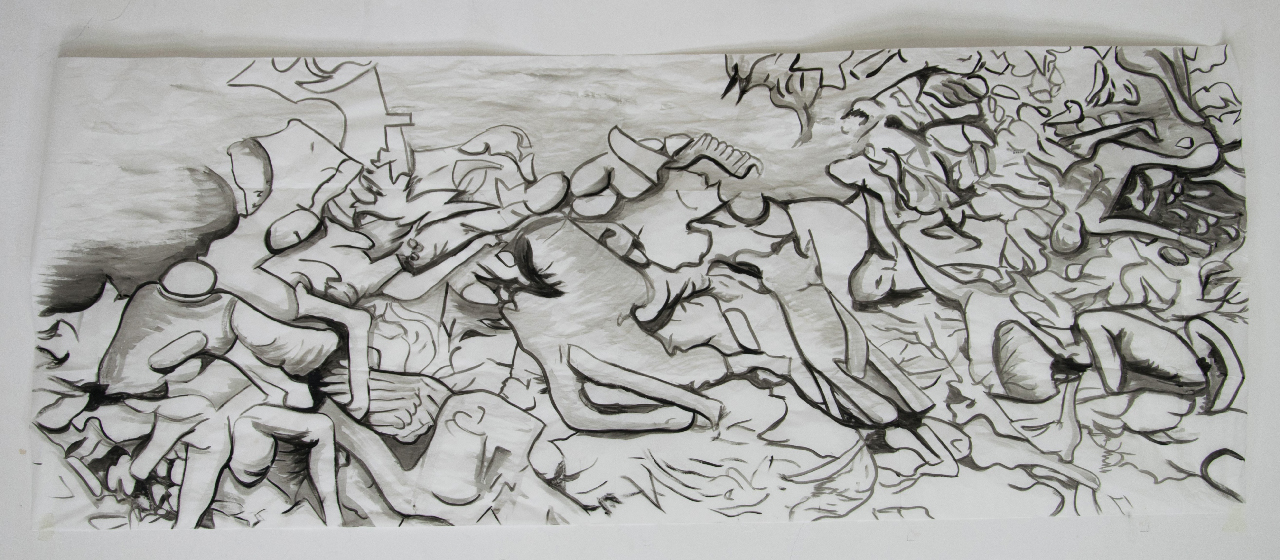
In this sense, Easy connects two lines of the project: dead bodies and military machines. The machines in the first part of Legko are fragments, ruins, technologies that have lost their function of killing. The bodies in the second part are those who have already found themselves inside the catastrophe. A cause-and-effect relation emerges between them, but it is not stated directly: the viewer moves from the earth, where broken aircraft lie, to suspended sheets with bodies that “look at the viewer from the sky” and at the same time resemble a “storm cloud” — a sticky, dirty, heavy mass of the dead.
Grigorii Sokolov, in his text “Обретение нежности” / “The Acquisition of Tenderness,” [3] describes this transition through the state of bodies that no longer fully belong either to life or to death. He writes that in my work, objects usually considered inanimate “acquire qualities associated with life”: they long, dream, strive to stop. In the second part of the exhibition, where Battle Scenes appears, the bodies are “mixed into a heap, intertwined, stitched together by time, death, and evil will,” deprived of faces and names. Yet it is the viewer’s gaze that gathers them again from fragments “down to the bones” and returns visibility to them.
This idea of visibility is crucial to the series. Battle Scenes does not restore a full biography to the dead — that is already impossible. It returns to them at least the status of visible bodies. Not statistics, not symbols, not illustrations of military history, but bodies that demand presence and attention. In this sense, the series operates between document and dream: it begins from photographs and historical material, but through drawing transforms them into a space of suspension, a dark cloud of memory.
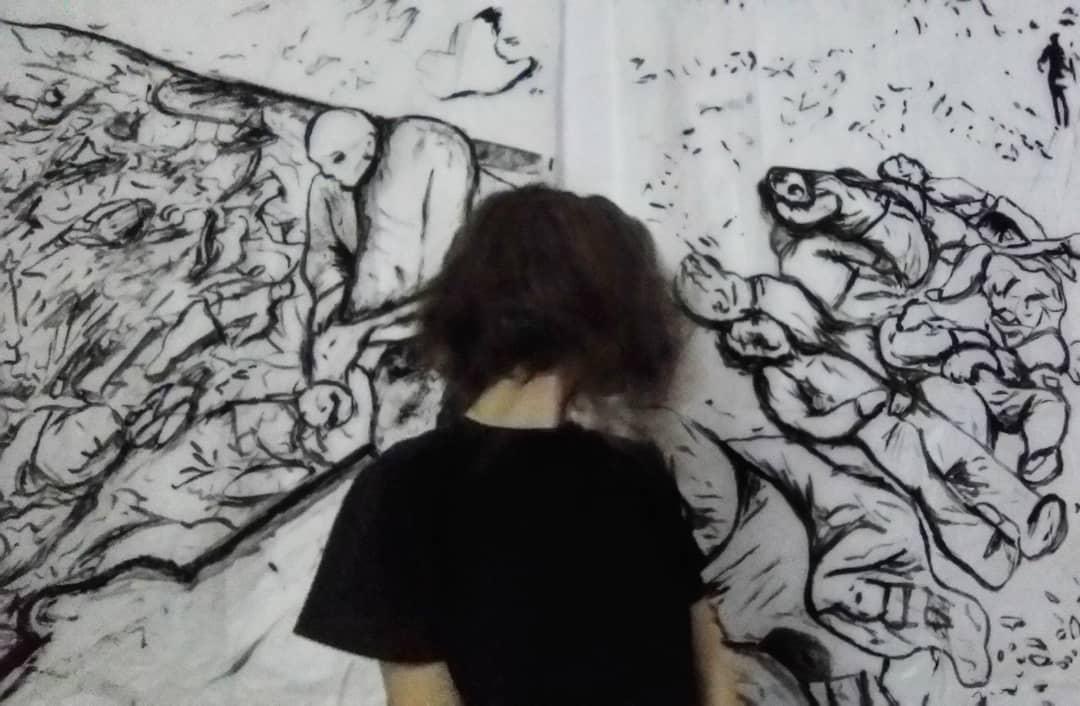
Sofronov connects this work to the broader theme of historical memory in my practice. He writes that the politics of memory is one of my recurring concerns, and that artistic production can activate memory mimetically — through image-making, repetition, and bodily proximity to traumatic material. In his interpretation, the project is connected less with the impossibility of representing trauma than with the work of grief, mourning, and the return of memory to the victims.
Within the space of the exhibition, Battle Scenes was not the final point, but a transition. Before it was the series Bodies/ Beds— small drawings and beds in which each dead person is given a separate place. If in Battle Scenes the bodies are still stuck together in one mass and suspended halfway, then in Bodies/Beds each one is separated, gathered, laid down, almost at home. In the interview, I formulated it this way: if earlier “all the unfortunate dead formed one indivisible whole,” then in the third part “each finds their own rest and settles into a personal little bed.” [2]
For this reason, Battle Scenes can be understood as the central and heaviest part of the project: it is not yet care, not yet rest, not yet the possibility of sleep. It is the moment of confrontation with the mass of the dead — with something that cannot be untangled without effort and can hardly be endured by the gaze. The series fixes the state before consolation: the bodies have already been pulled out of historical invisibility, but have not yet been given a separate place.
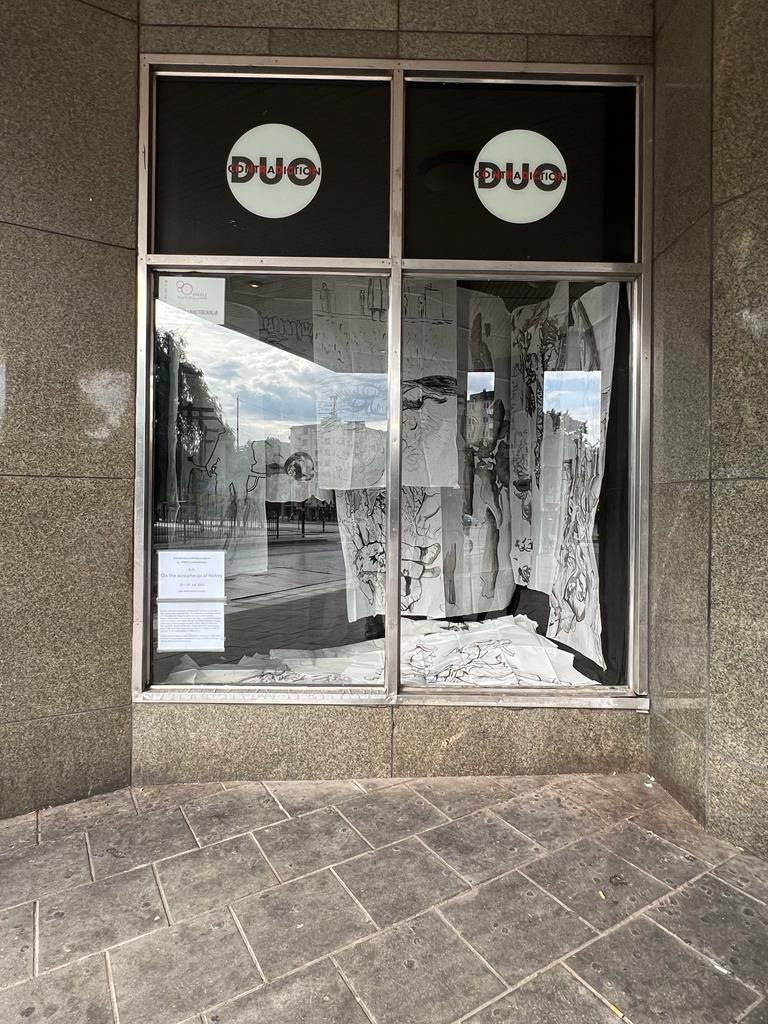
In 2023, Battle Scenes was also presented anonymously in my solo exhibition On the Scrapheap of History at DUO Contradiction, Stockholm, Sweden. In this later context, the series entered a broader reflection on historical debris, obsolete forms of violence, and the afterlife of images and materials left behind by political catastrophe. The title of the exhibition — On the Scrapheap of History — extended the logic already present in Battle Scenes: history appears not as a completed narrative, but as a heap of remains, fragments, bodies, machines, and visual traces that continue to demand attention.
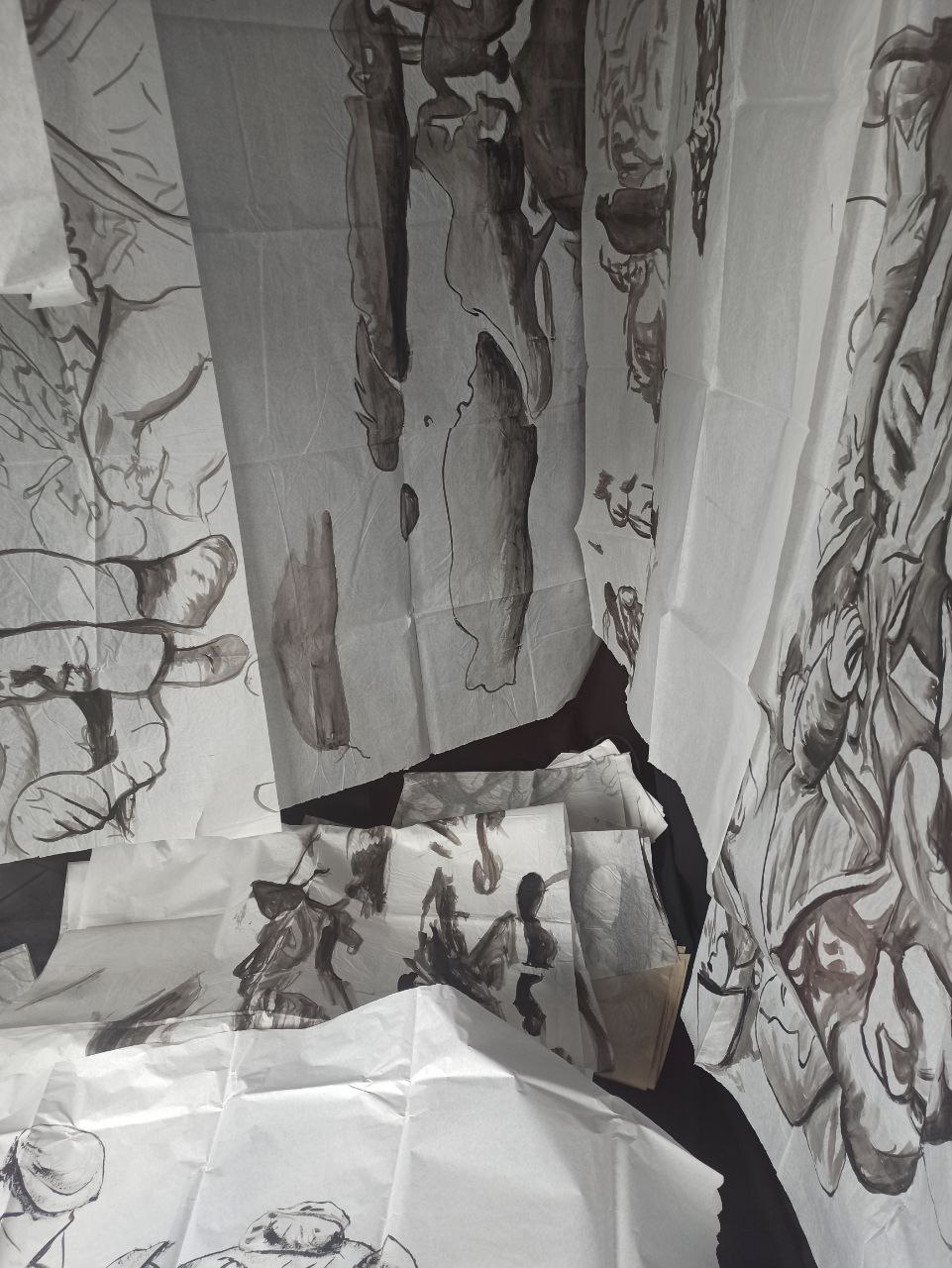
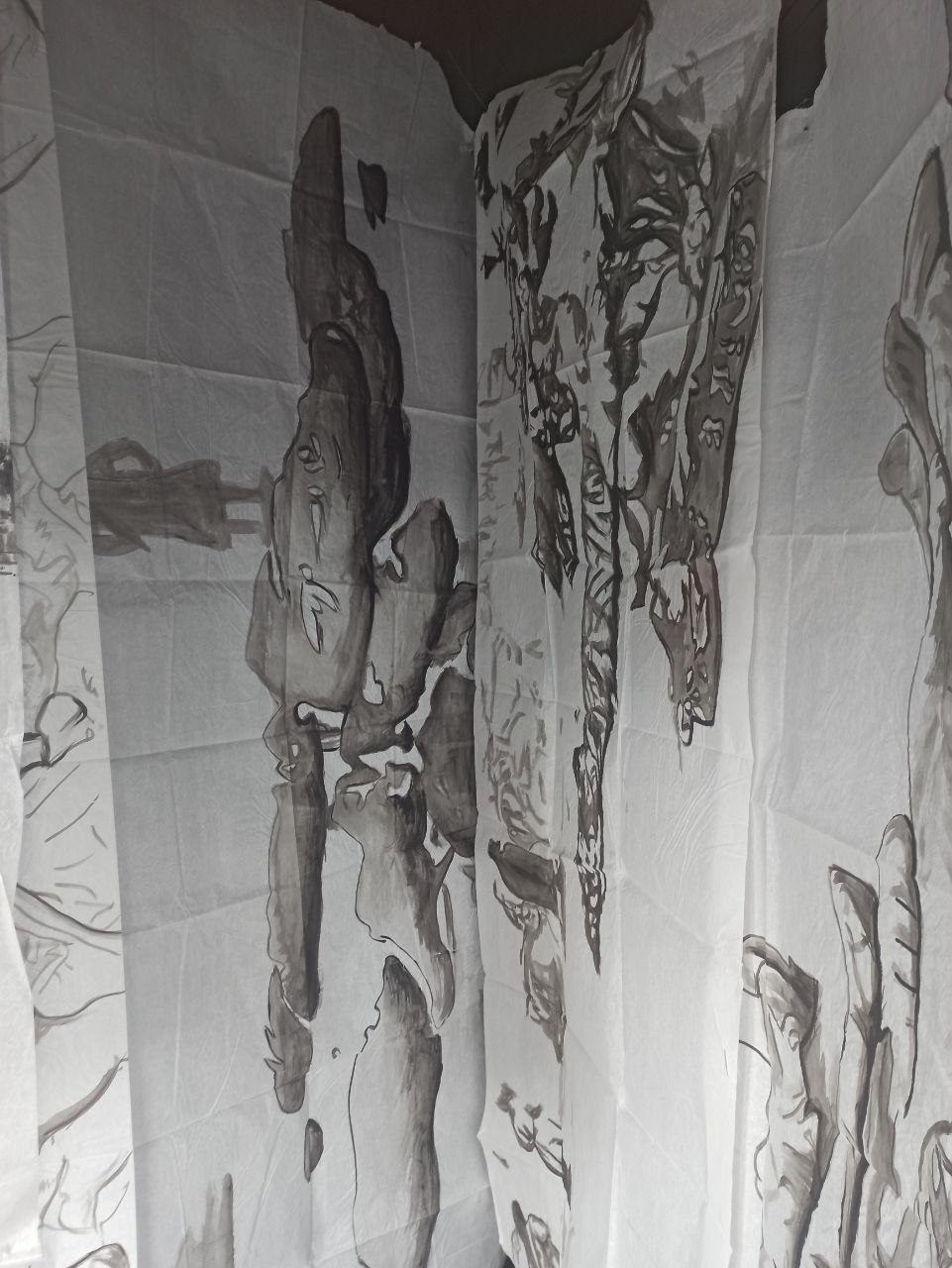
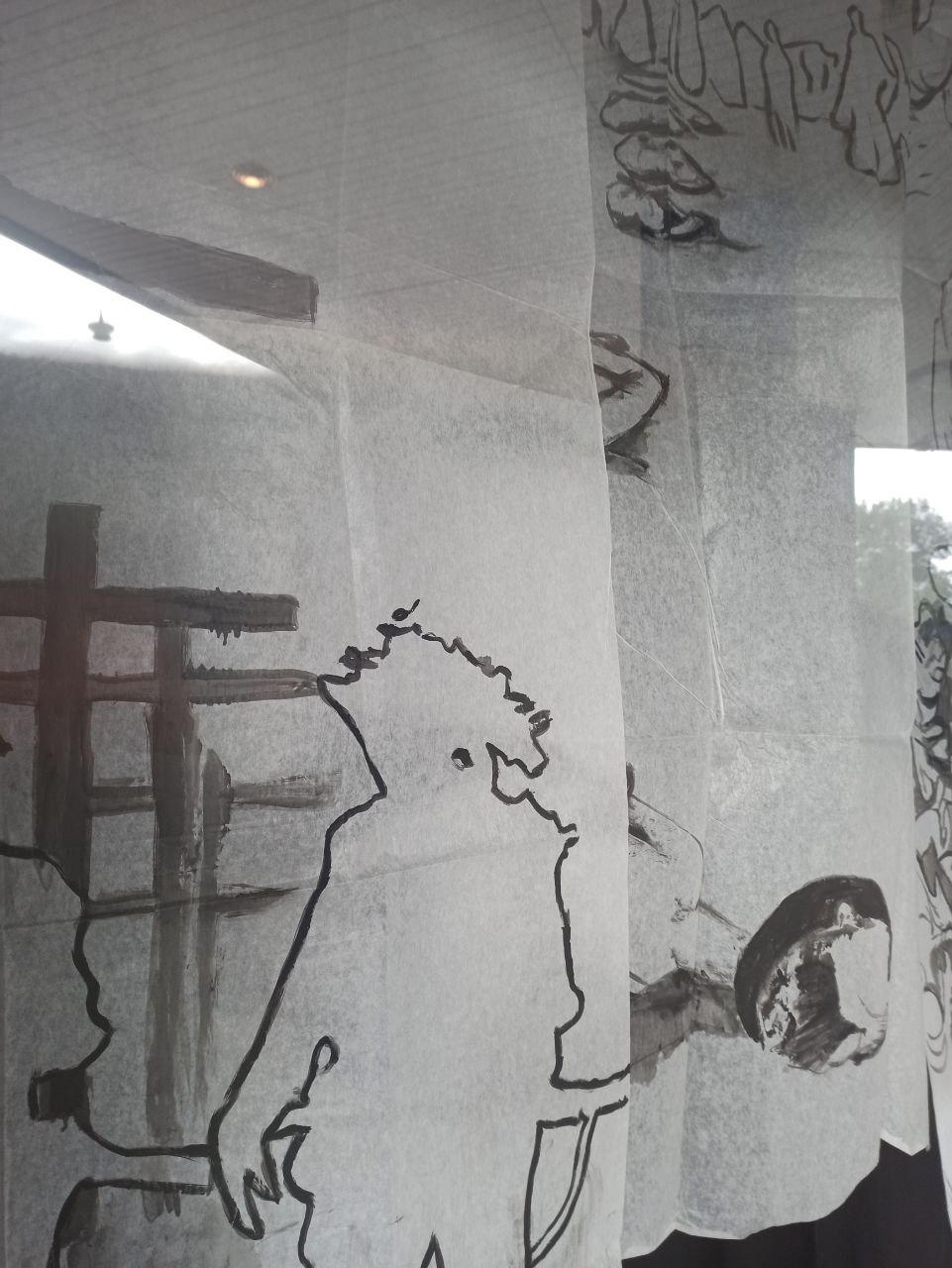
Battle Scenes is a series about the impossibility of burying history as a completed past. The dead do not disappear here. They return as a mass, a cloud, a fold, a line, a dark stain on thin paper. The work begins with horror at the number of unidentified bodies, but gradually becomes a form of attention: to look, to distinguish, to separate, to return visibility — and then to search for an individual place of rest for each body.
Related exhibitions
Easy / «Легко», project VZLET. Solo exhibition, curated by Sergey Popov, VDNH, Pavilion Cosmos, Moscow, Russia, 5 December 2018 – 8 January 2019.
On the Scrapheap of History, DUO Contradiction, Stockholm, 2023.
Related texts
1. Софронов, Егор. «Конечно, всё это про слабость». Aroundart, 21 декабря 2018. http://aroundart.org/2018/12/21/vepreva-vzlyot-slabost/
2. «Анастасия Вепрева: Я последовательно уничтожаю военные машины». Искусство, 2018. https://iskusstvo-info.ru/anastasiya-vepreva-ya-posledovatelno-unichtozhayu-voennye-mashiny/
3. Соколов, Григорий. «Обретение нежности». К.Р.А.П.И.В.А., 4 января 2019. Рецензия на выставку Анастасии Вепревой «Легко», проект «ВЗЛЁТ», ВДНХ, Москва. Архивная копия / PDF.
Publication
Vepreva Anastasia. Легко / Easy. Exhibition book published on the occasion of the solo exhibition "Easy", project «ВЗЛЁТ». Moscow, 2019. Download PDF